|
|

|
|



|
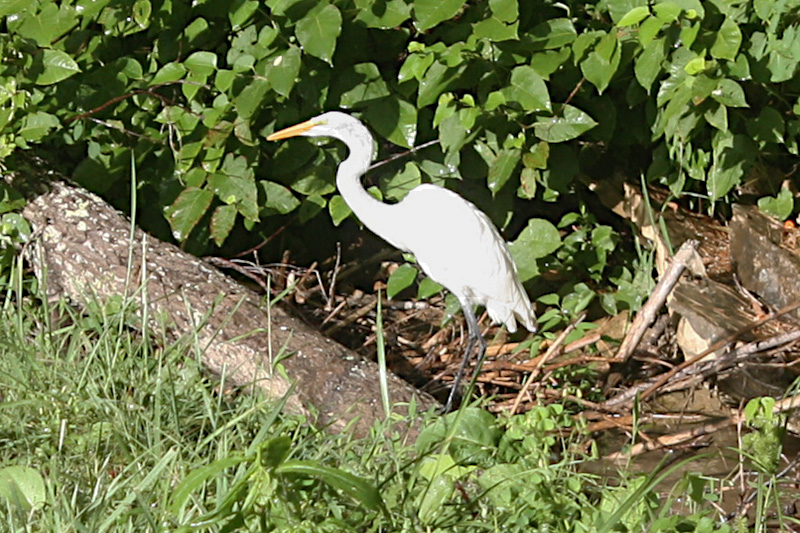
Great Egret on Walnut Creek. |
|
Having grown accustomed to seeing Great Blue Herons on Walnut Creek, I was stunned when I saw this bird on the creek nine years ago. I assumed it was some type of heron, but I wasn't really sure until I did some research and identified it as a Great Egret, which is a type of heron that has all white plumage. Compared to a Great Blue Heron, they are typically smaller, more slender, and have black legs and feet. The egret appeared on a sunny day after a period of high water and was perched over the creek on a fallen red oak tree. The tree fell five years before in a strong wind while the debris behind the bird and the muddy water is from the recent flooding. |
|
|
|
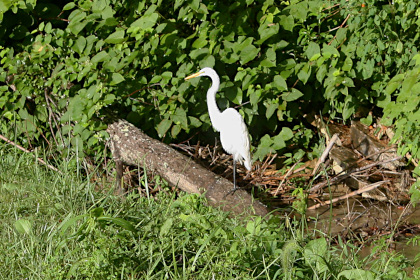
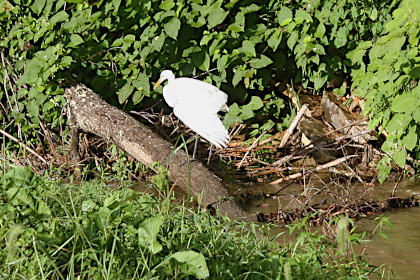
I haven't seen a Great Egret here in all the years since this one, so I'm glad it was so accommadating and allowed me to photograph it. It was a little upstream from the studio, so I had to get closer, but unlike the Great Blue Herons the egret did not fly when I left the studio. In fact, it was very photogenic and even seemed to be striking different poses for me. The Great Egret is the symbol of the National Audubon Society, an organization founded in part to protect the bird from extensive plume hunting to adorn women's hats, a practice that nearly drove the egret to extinction in the late 19th century. |
|
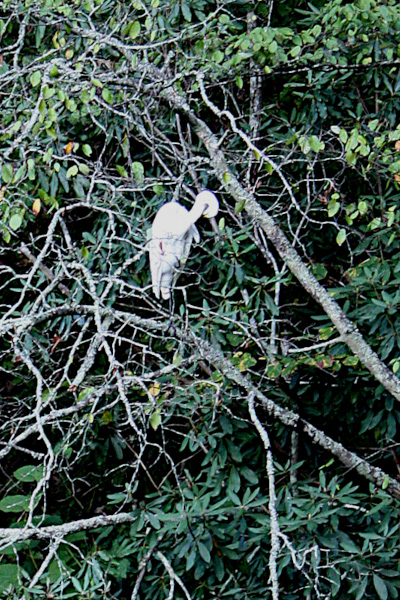
The egret came around almost daily for about a week and I refrained from taking any more photographs so as not to bother it. I was happy with the photos I had until one evening I saw it perched in a small tree, preening itself, right across the creek from the studio. Even in the dimming light it was a striking image. I took some photos and then left it alone again, wondering if it was going to roost there. That was unlikely because I read later that they prefer tall trees near a large body of water. Also they roost in large communal rookeries, which obviously would be difficult here. At any rate, it didn't matter, because the Great Egret wasn't there in the morning and never returned.
I've learned that the Great Egret has inspired profound symbolism in many cultures. With its striking appearance, especially its pure white plumage, the Great Egret has become a symbol of purity and grace. Many native American tribes associate the egret with peace and harmony, sometimes casting it as a wise elder. Some cultures see the egret as a messenger from the spiritual world, bringing divine guidance. And my favorite: In many African spiritual traditions, the egret's solitary flight represents freedom and independence. The bird's journey across vast landscapes symbolizes personal liberation and the pursuit of one's destiny.
|
|
|
|