|
|

|
|



|
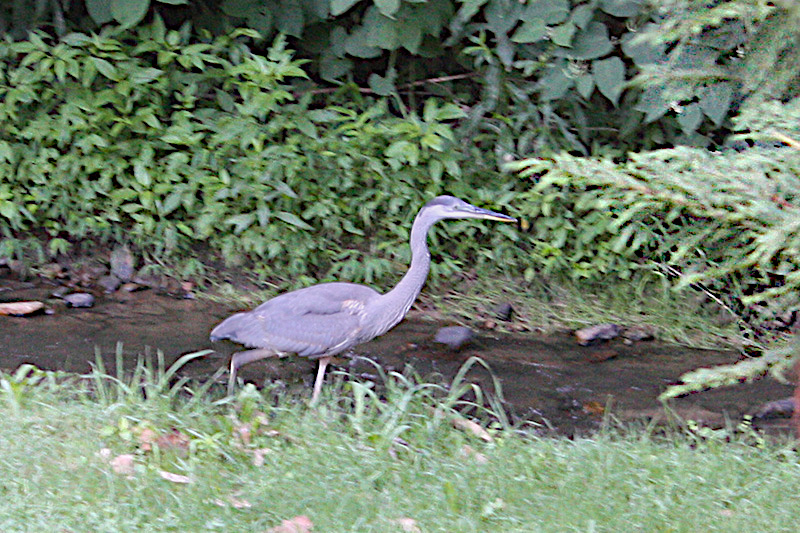
Great Blue Heron moving along the bank of Walnut Creek. |
|
Great Blue Herons are a common sight on Walnut Creek, but no matter how many times I see them, I always stop work to observe any time they appear. Silence and stillness are necessary to observe them, because unlike much of the other wildlife that will tolerate my presence so long as I'm inside the workshop, the herons will often take flight even if I simply turn my head too quickly. The Great Blue Heron is described as a large wading bird known for its distinctive blue-gray plumage, long legs, and S-shaped neck. It is the largest heron in North America with a habitat that includes North and Central America, the Caribbean, Galapagos Islands, and Walnut Creek in North Carolina, behind my studio. |
|
|
|
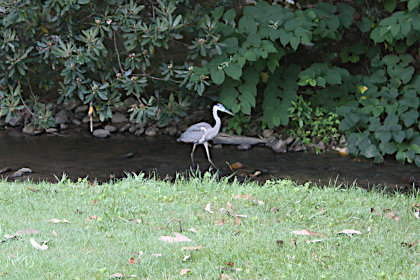
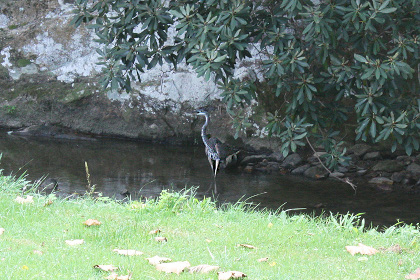
With a diet that consists mainly of fish, the creeks and rivers in Western North Carolina provide many feeding opportunities for Great Blue Herons. Their diet also includes frogs, snakes, mice, voles, crayfish, crabs, and even small birds. Behind my studio Walnut Creek runs along a steep hillside with a rock face at water level. At the base of this is a trench that is about two feet deep even in times of little rain. The heron in the picture to the left is standing right in the trench and for good reason. This channel is usually teaming with small fish and minnows. I can speak from experience on that matter because in warm weather I often dunk in the trench to cool off, and if I sit still, fish will soon surround me and peck at me from all directions. |
|
Don't tell anyone I said that because if the grapevine starts buzzing that the old woodcarver sits in Walnut Creek, and lets fish peck him, they'll cart me away for sure. Anyway, being somewhat acquainted with the fish, I feel for them, but at the same time I'm fascinated with how the herons go about their fishing. When the herons fish they get down low with their heads close to the water, and move very slowly or stand still, waiting for prey to come within range. Then in a flash their beak plunges into the water and resurfaces with a fish. Great blue herons grab smaller prey outright in their mandibles, but spear larger fish by impaling them with their sharp, dagger-like bills. After I learned this, I watched more closely and saw that larger fish are indeed stabbed, shook free of the beak, and then grabbed in the birds mandibles. One time a heron had to shake it's head several times before the fish slid off its beak, and then snatched it out of the air. It all happened so quickly that had I not been anticipating the spearing, I would have thought the fish was just grabbed and then flipped into a more convenient position to eat. Whatever methods are employed to catch the fish, big or small, they are then swallowed whole. Although late summer to winter are considered the prime months to observe them in western North Carolina, fortunately Great Blue Herons are present in this area year-round. |
|
|