|
|

|
|



|
Eastern Box Turtle |
|
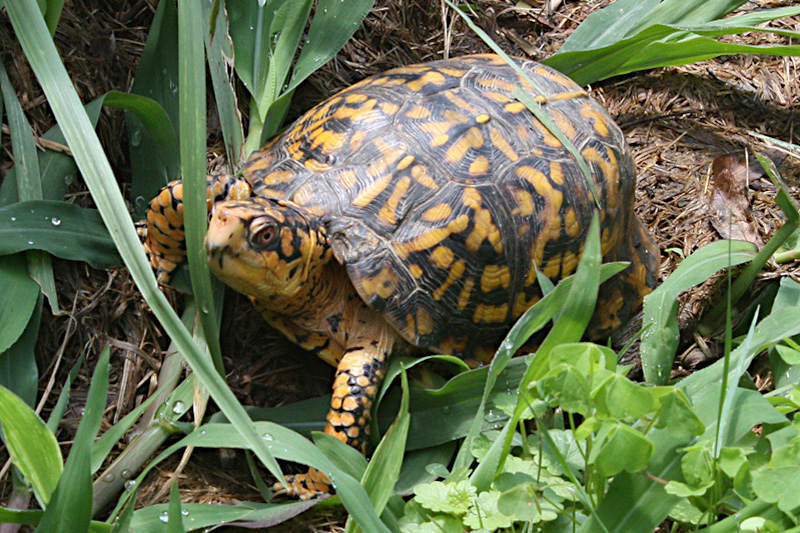
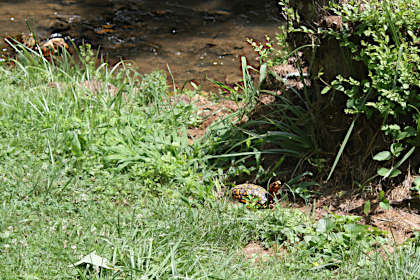
From the kitchen window I spotted this Eastern Box Turtle moving up the bank of Walnut Creek and went out to greet him. A creek bank is the sloping land immediately alongside the edge of a creek that confines the normal flow of water within its channel. I take care of the bank along Walnut Creek, mostly by leaving it alone. Besides stabilizing the bank, and filtering water, healthy vegetation on the bank provides habitat for wildlife, so it's nice to see some wildlife taking advantage of it. Box turtles are common here and I see many in the warm months, but this was one of the more sociable turtles I have encountered. |
|

|
|
When the turtle reached level ground, it paused for a few photographs and then headed in the direction of the studio and whatever was planned for the day. I headed back in the direction of the kitchen and the dishes I had been washing. The scientific name of the Eastern Box Turtle is Terrapene carolina carolina, so called because the species was first identified in the Carolinas. It is described as a small, long-lived, terrestrial turtle native to the eastern United States, known for its ability to completely enclose itself within its hinged shell for protection. Other species, such as mud and musk turtles, also have hinges on their shell that allow them to close partially, but not completely like a box turtle. |
|
|
|
|
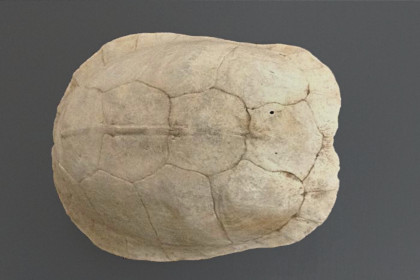
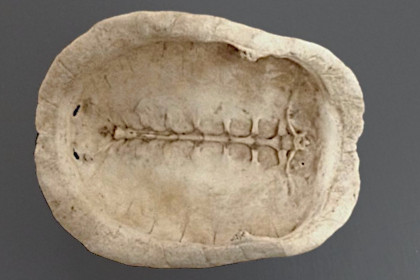
My canine companion, Tucker, has a remarkable sense of smell and often tracks down box turtles that I would never spot in the field where we walk. Once discovered he sniffs the turtle a time or two and walks away, showing little interest. My interpretation of this behavior is that from his point of view, these creatures don't run, or fight, or play, so what good are they. They just turn into a closed, hard box, about as much fun as a rock. Tucker doesn't seem to appreciate that it's this boring, passive, box-like behavior that enables this small and docile animal to live a relatively long and trauma free life. Eastern box turtles live for 40 to 60 years on average, a lot longer than dogs. On a morning after days of high water on Walnut Creek, Tucker and I were walking along the water edge after the creek had receded. He had his nose down low taking in the novel scents that had washed downstream. Suddenly he paused over the water, plunged his head in, and came up with the upper part of a box turtle shell (pictured above) in his mouth. When I realized what it was, I bargained it away from him with a treat, and upon examining it, I knew I had made a good trade. The top part of the shell, called the carapace, is part of the turtle's skeletal system and is an anatomical fusion of a turtle's ribs and spine. This specimen is worn but intact with fairly well defined details. My guess is that the shell was washed out by the high water from someplace upstream where it was protected and preserved for some time. Otherwise it would have been damaged or gnawed on like other turtle shells I've found. Besides, at that time, Tucker and I walked along the creek almost daily, and he would have found it before then. That was a chance finding years ago, and the box turtle carapace has sat on my writing desk ever since. Not quite as dramatic as a human skull that a philosopher of old might have kept on their desk, but instead, a small and docile memento mori, dramatic enough for me. |
|
|