|
|

|
|



|
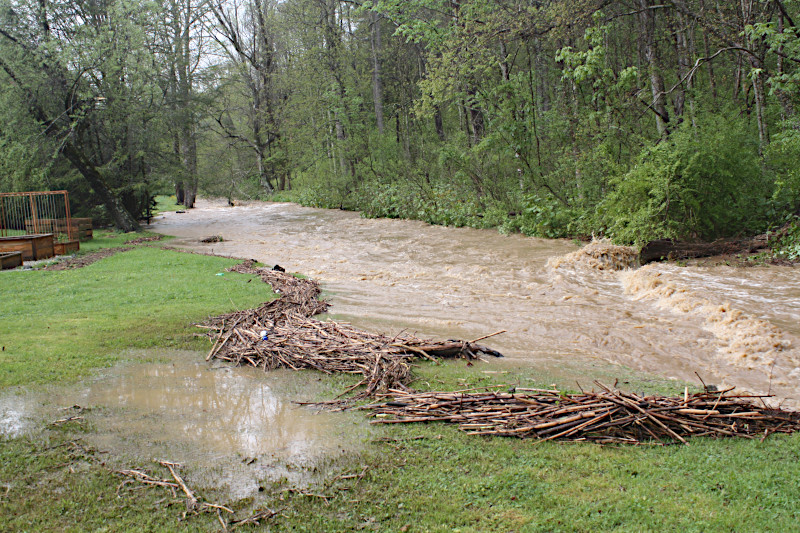
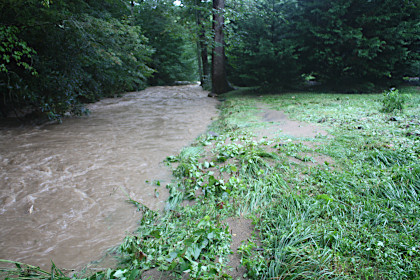
Walnut Creek during the flood of 2019. |
|
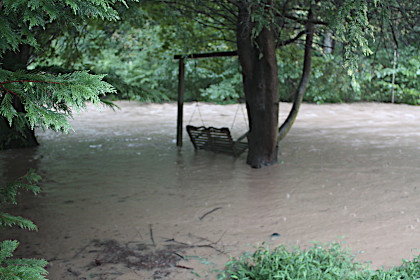
On April 19, 2019, heavy rain resulted in Walnut Creek jumping its banks and causing significant erosion. Other floods that I have experienced here, such as the flood of 2013, pictured to the right, have resulted in higher water levels, but five inches of rain in a matter of hours, which preceded the torrent pictured above, caused the water to flow with destructive force. When I first arrived at this property the creek bank behind the house and the building which was to become my studio was lined with hundreds of rocks of various sizes. It looked to be a formidable defense, and is exactly what I would have done to prevent erosion, that is until I learned more about it. |
|
|
Just six months before this flood I read that using rocks or broken up concrete slabs, which are commonly used on the banks of Walnut Creek, is a temporary fix at best. Sooner or later enough water will come with enough force to move just about anything placed on the bank, and then the underlying soil, without the benefit of grasses, shrubs, and trees to hold it in place with roots, would be particularly vulnerable to erosion. I came to appreciate that information with the flood of 2019 because all the rocks that my predecessors had lined the creek with were gone when the water receded and so were large sections of the creek bank itself. In some places the creek bed had widened by as much as five feet. The same article that foretold the fate of the rocks on the creek bank and the erosion to follow recommended a different approach, employing techniques to restore the creek bank to a more natural state. First by grading steep, vertical cut banks back to a more stable slope, about a three foot rise from the creek toward the floodplain for every foot of elevation from the creek bed. The next recommended step was to plant native shrubs, and grasses to hold soil during high water, rather than covering the bank with rocks or concrete. I started this grand restoration project with shovel and wheelbarrow in the fall of 2019 by filling in the worst erosion damaged areas with dirt and sod garnered from other projects that were ongoing. |
|
|
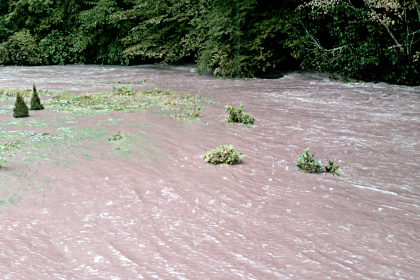
Sod in this instance refers to clumps of dirt held together by roots of various plants, and for my purposes seemed to be the ideal filler. The project required many wheelbarrow loads, tons of filler, and was not finished until Spring of the following year. Fortunately no floods or destructive high water tested the bank that year so that the grasses and shrubs that I planted on the repair job were able to establish themselves and cover the bank. The test came in the summer of 2021 with the flood pictured to the left that came in the aftermath of Tropical Storm Henri. |
|
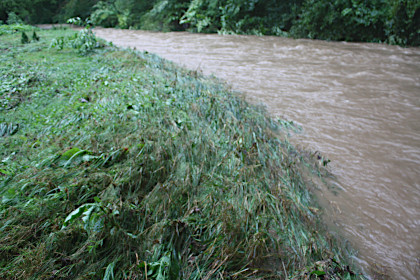
The rain from Henri swelled Walnut Creek to the high water mark since I've lived here. Water came within fifteen feet of the house, flooded the garden, and was flowing right under the workshop window from where the above photograph was taken. But when the water receded, there was no erosion along the section of the creek bank that I had restored. Not only did the network of roots hold the bank together, as pictured to the right, the grasses and shrubs flattened out in the direction of the water flow and formed a heavy mat that helped to hold the surface soil from washing away. |
|
|
|
As a bonus, along the creek bank directly behind the studio, pictured at the left, the flood waters left a layer of sand and silt so that there was a net gain of soil this time. Since 2021 Walnut Creek has not left it's banks, although there has been high water a number of times. I leave the vegetation on the banks alone for the most part except to encourage more shrubs and small trees to join the mix. The creek is wider and more natural looking now that its not pinched in by the rock wall, which is fine with me. I consider Walnut Creek to be the best feature of this property and I'd much prefer more creek and less yard. |
|
|