|
|

|
|



|
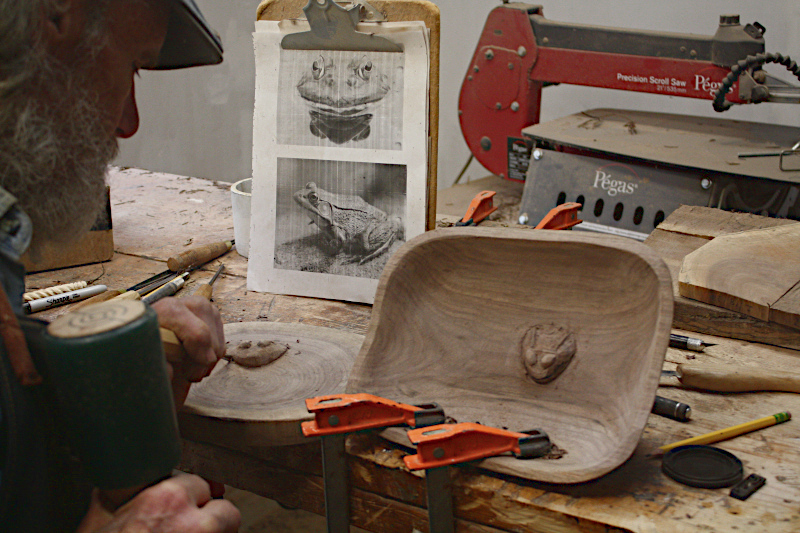
First sign of spring, frogs emerging from Black Walnut.
|
|
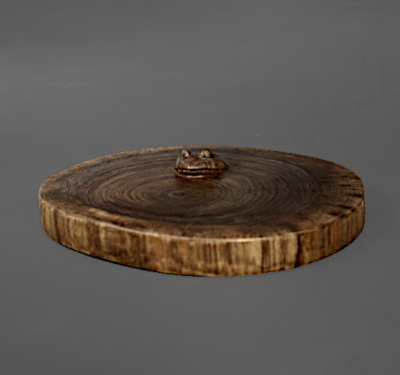
The finished piece to the left, titled Treefrog, is the one that I'm working on in the top photograph. It appears to be a simple piece, but is actually fairly difficult. With an electric chain saw I cut a two inch cross section from a small walnut log and roughed out a triangular area for the frog head. Then as I do with all pieces, I put a date on it and shelved it to dry. A piece this small and with so much end grain exposed will dry quickly, but as it turned out it sat on the shelf for over a year before I got back to it. So, it was quite dry, and fortunately had not cracked or warped. The difficulty in this piece comes first from the fact that most of the time I was working into end grain, rather than cutting at more controllable angles parallel to the grain. The tools needed to be very sharp to avoid chipping out more wood than desired. |
|
|
|
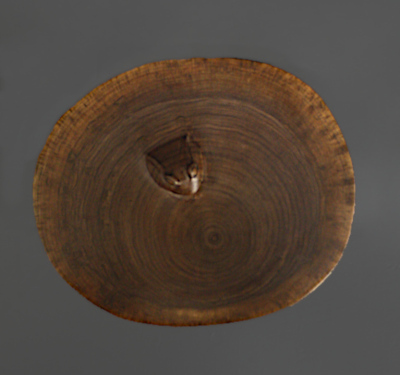
The second difficulty in pulling off this piece is in getting the frog head at the right level so it appears to be just above the surface of the water, and then removing the tool marks to level the water around the frog. None of it is especially difficult technically. It just takes a little experience and a lot of time and patience. I think it's an interesting illusion, particularly on walnut end grain, so I do it again usually after enough years have passed and I forget the difficulties. When I was cutting this particular walnut log, which was first cut from a large limb of the tree, I saw that the growth rings were well off center and thought that that could be used for an interesting orientation of the frog in the piece and so was motivated to do it again. |
|
When a tree or a limb is growing on a lean, it creates what is called reaction wood. Reaction wood is thought to be a response by the tree to get back to a vertical orientation and to assist in maintaining the angles of branches. More specifically, in hardwoods, it's called tension wood and is found on the side of the tree or branch opposite the lean. This results in the center of the growth rings being pushed to one side. So when the tree was intact, the frog was located in tension wood on the top side of the limb close to the main trunk and looking in the direction that the limb was leaning, down and away from the trunk. The limb was protruding out beyond the top of the frog's head. Reaction wood has increased ability to absorb and release moisture, resulting in much greater swelling and shrinking than in normal wood. It's considered a defect in sawn lumber due to its tendency to warp and crack. Also, tension wood fibers tend to pull out during sawing and planing operations, producing fuzzy or woolly grain. Neither of these were an issue in this short section of the log that I used. My first thought was to place the frog directly in the center of the circles, to maybe suggest ripples in the water caused by the frog surfacing. But then, considering how dark walnut gets upon finishing, especially end grain, I thought the frog would obscure the small circles, so I lined it up the way it is. Imagine instead that the frog has been sitting and waiting and an insect has dimpled the surface just inches away from its snout. |
|
|